"The Control of Canine Halitosis By Sugar Cane Polyphenols: Effects and Potential Mechanisms" Journal of Agricultural and Food Chemistry
Pet owners love their dogs but may not always love the smell of their breath. Because this bad odor can signal oral disease, veterinary clinics will prescribe daily tooth brushing, antibiotics or chemical rinses as treatment. Now, researchers reporting in ACS' Journal of Agricultural and Food Chemistry propose an alternative: polyphenols from molasses. They developed a spray that reduced stinky breath and harmful oral bacteria in dogs.
The spray itself has a mild plant-like and molasses-like smell, but it is not strong or unpleasant." - Hongye Li
Hongye Li
"Our goal was to investigate if a sustainable agricultural by-product could safely improve the daily oral health of our pets," says Hongye Li, the lead author of the study.
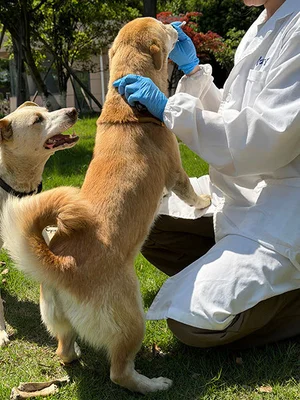
Previously, Li and colleagues examined sugarcane molasses and determined that it contained polyphenols that prevented the growth of harmful oral bacteria in lab cultures. They saw an opportunity to investigate whether similar extracts could treat the bacteria that cause halitosis, or bad breath, in dogs. So, Li, Yin Fei and Wei Zhao recruited 10 healthy pet dogs with smelly breath (after getting consent from their owners) and tested how a molasses-derived mouth spray impacted the animals' breath, oral microbiome and saliva composition.
The researchers sprayed polyphenols extracted from molasses into each dog's mouth, took saliva samples and monitored the smell of the dogs' breath. After an hour, the odor perceived by trained human evaluators was negligible, and the amounts of some bad-smelling compounds - including esters, amines and aldehydes - in the dogs' saliva were undetectable with gas chromatography-mass spectrometry (GC-MS).
"The spray itself has a mild plant-like and molasses-like smell, but it is not strong or unpleasant," explains Li. "Importantly, the deodorizing effect was not simply due to odor masking, because the GC-MS results showed reductions in several odor-associated compounds in saliva."
To test longer-term effects, the dogs received mouth spray daily for 30 days. After this time, the dogs' saliva contained smaller amounts of aroma compounds, including aldehydes and short-chain fatty acid esters that contribute to fatty odors and are produced by pathogenic bacteria. Their oral microbiomes also contained significantly smaller proportions of bacteria associated with bad breath, including Porphyromonas and Fusobacterium.
After conducting additional lab experiments and computer simulations, the team better understands how the polyphenols and odor molecules interact. Li describes the spray treatment like a sponge, a switch, and a gardener. "First, the polyphenols act like a 'molecular sponge,' directly binding to and neutralizing existing bad odor molecules," Li says. "Second, they act as a 'switch' to turn off specific bacterial enzymes that produce foul smells. Finally, they work as a 'gardener' to weed out the populations of bad odor-causing bacteria over time."
The researchers emphasize the importance of this multifaceted treatment as a simple, safe and sustainable way to keep family pets healthy, which they hope will ultimately bring pets and their families closer together.
The authors acknowledge funding from the National Key Research and Development Program of China, the National High-Level Talents Special Support Program, Jiangnan University, and the Fundamental Research Funds for the Central Universities.