
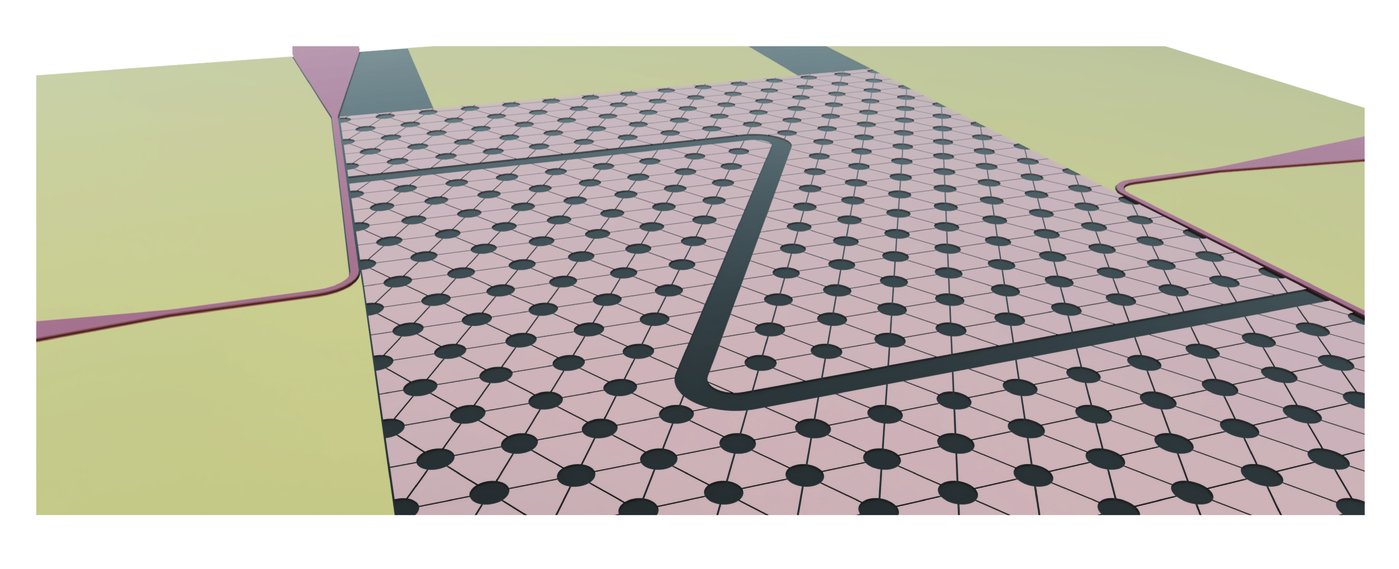
A research team from Tohoku University, Shin-Etsu Chemical Co., Ltd., and École Polytechnique Fédérale de Lausanne (EPFL) has invented a new way to efficiently guide spin waves around sharp corners with minimal loss - representing an exciting discovery for energy-efficient computing. Using a two-dimensional magnonic crystal - a copper (Cu) film with a hexagonal array of tiny holes placed on a magnetic garnet film - the team showed through calculations that spin waves travel along a Z-shaped path over 5,000 times more efficiently than in conventional waveguides.
As artificial intelligence and data centers consume ever more electricity, heat from conventional electronics has become a serious problem. Spin waves are ripples of magnetization in a magnetic material that can carry information with far less heat than moving electrons, making them promising for reduced-energy computing. However, spin waves weaken quickly as they travel, especially when a waveguide is bent. This signal loss has long been the biggest obstacle to building practical spin wave circuits.
In the present study, the team inverted an earlier concept they developed in 2024: instead of placing Cu disks on garnet, they placed a Cu film perforated with a hexagonal array of holes, with thin slits connecting neighboring holes. Three-dimensional electromagnetic simulations showed that this new structure produces a "complete magnonic bandgap" capable of reflecting spin waves regardless of their incoming direction. This is the first report of a complete magnonic bandgap in a two-dimensional magnonic crystal based on a magnetic garnet. A patent application for the core waveguide structure has already been filed.
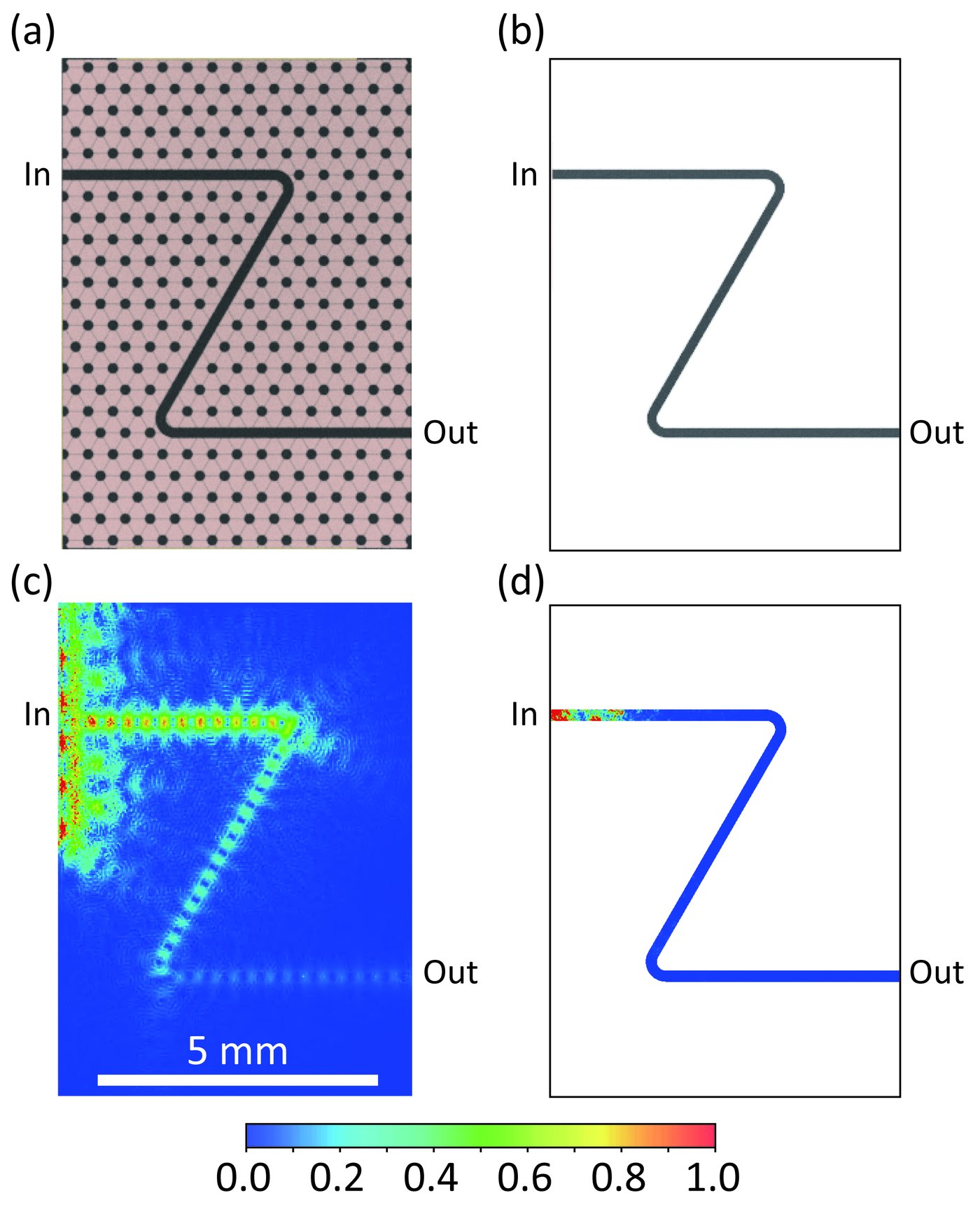
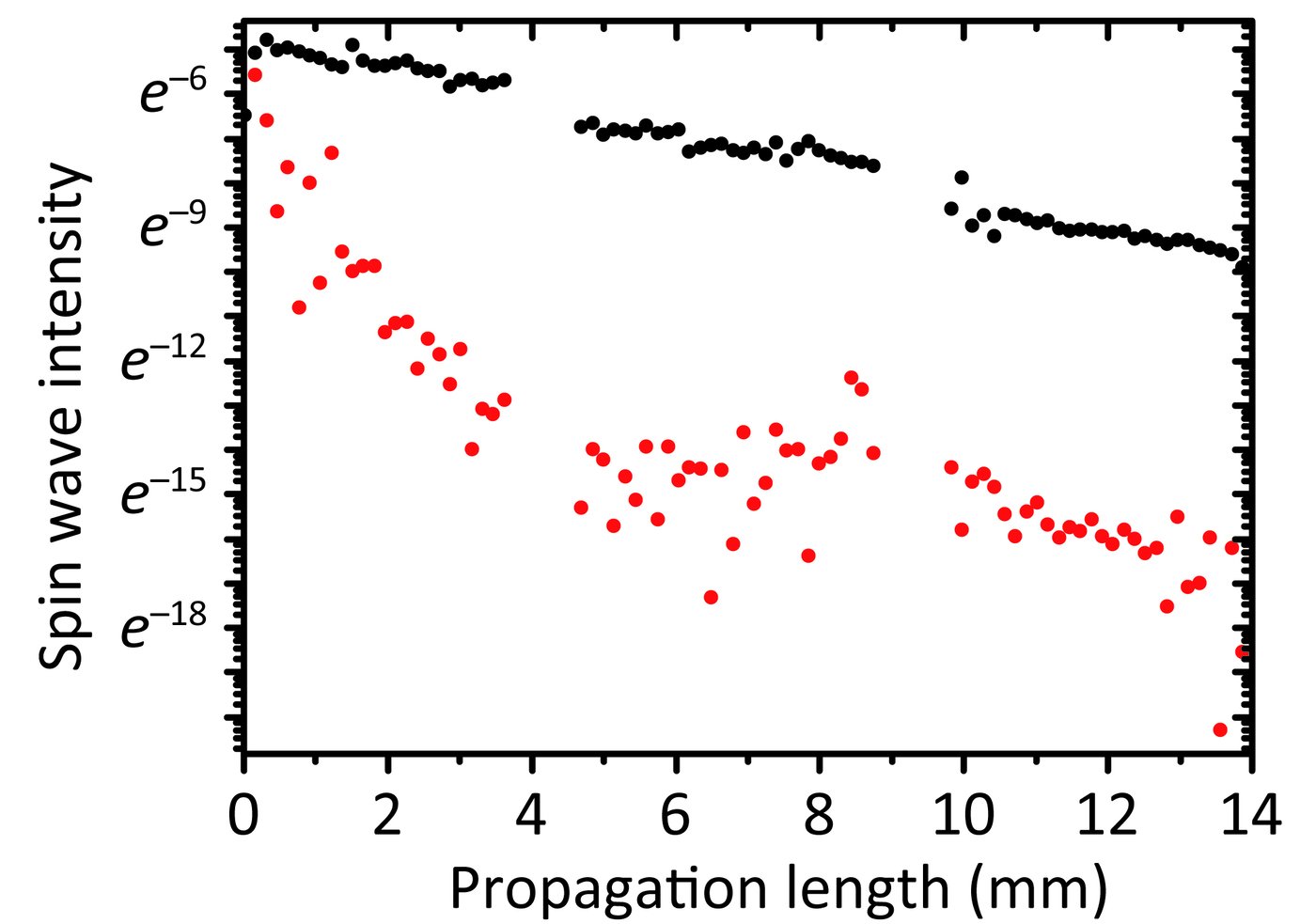
The team then created a Z-shaped path through the crystal by removing a line of holes, forming a "line defect". While the convention ridge waveguide spin waves didn't make it to the end, spin waves following the new method did. The new waveguide transmitted spin waves over 5,000 times more strongly than the conventional design.
"Bending a spin wave without losing it has been one of the hardest problems in this field," said Associate Professor Taichi Goto from Tohoku University's Research Institute of Electrical Communication. "By turning the problem inside out - placing a patterned metal film on the magnetic garnet instead of cutting the garnet itself - we found a way to guide spin waves around sharp corners with very little loss. This opens a practical route toward integrated spin wave circuits that could one day help data centers run on a fraction of today's electricity."
The findings were published in Physical Review Applied on May 27, 2026.
- Publication Details:
Title: Z-shaped waveguides using complete band gaps in magnonic crystals of yttrium iron garnet and a copper hole array
Authors: Kanta Mori, Takumi Koguchi, Toshiaki Watanabe, Hibiki Miyashita, Dan Shabaev, Dirk Grundler, Mitsuteru Inoue, Kazushi Ishiyama, Taichi Goto
Journal: Physical Review Applied
DOI: 10.1103/m64z-lh2m


