
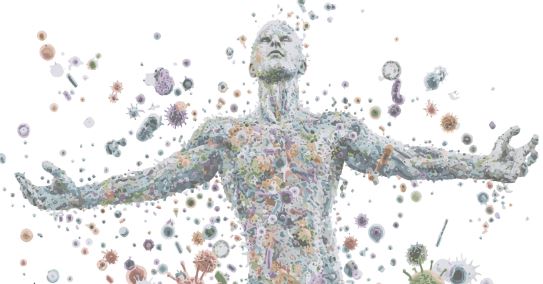
Can you imagine feeling good about your body being home to trillions of bacteria, viruses - as well as life-giving 'invisible friend' microbes in the air, soil and water?

Before you say yuck, this concept is a new way microbiologists are encouraging people to think about their place in the world - and the important ties between a healthy mind and body and the natural world.
"In our modern urban world, people can be far removed from nature - but concern for better health and wellbeing, and greater ecological and pro-environmental awareness are changing this," says Flinders University microbial ecologist Dr Jake Robinson, from the College of Science and Engineering.
To study the idea, Dr Robinson and colleagues explored the 'holobiont' concept (see attached) - that humans are symbiotic assemblages of a host of plus-trillions of microbes, which connect them with nature and the world around them.
"What happens when people learn we are not standalone organisms but walking ecosystems?" asks Dr Robinson, co-author of a new article published in the journal Ambio.
"Our research indicates that learning about the microbial dimensions of human life appears to strengthen people's psychological relationships with the natural world.
"The findings also suggest that microbiome literacy may do more than improve scientific understanding.
It may also reshape how people perceive their place in the living world," says Dr Robinson, a Senior Research Fellow in Restoration Genomics at Flinders University.
The concept might seem foreign given today's modern hygiene norms, and societal perceptions of even garden dirt as dangerous or undesirable.
However, the world's first 'holobiont intervention' has profound implications, researchers claim.
Researchers based the result on a randomised, blinded survey of 190 participants using the Nature Relatedness-6 (NR-6) scale alongside a holobiont knowledge intervention comprising a video and supporting information.

Co-lead author Dr Alexia Barrable, from the Queen Margaret University, Scotland says: "Perhaps one of the most profound consequences of microbiome science is not just biological but also psychological.
"Even a short holobiont experience can significantly increase nature connectedness scores, which are associated with greater wellbeing and concern for the environment," says Dr Barrable, a Senior Lecture in Social Science in the QMU Psychology, Sociology and Education Division.
"Our study shows that people with a greater understanding of the holobiont concept reported higher nature connectedness and willingness to embrace its benefits.
"Impressively, when people learn about the concept, it can increase their nature connectedness - and this increase is similar to nature-based interventions."
The research article 'Viewing ourselves as nature: Holobiont literacy influences nature connectedness' (2026) by A Barrable, K Robinson and JM Robinson - has been published in Ambio (Springer Nature Link open access) DOI: 10.1007/s13280-026-02414-x.
Also see the article - 'From risky play to dirty play: why young children need 'dirty' nature play in their lives' (2026) in the International Journal of Play (Taylor & Francis) - see Playful Green Planet.
Dr JM Robinson has published a series of books including Invisible Friends: How Microbes Shape Our Lives and the World Around Us. Also see the Nature. Gut. Nature website.


