
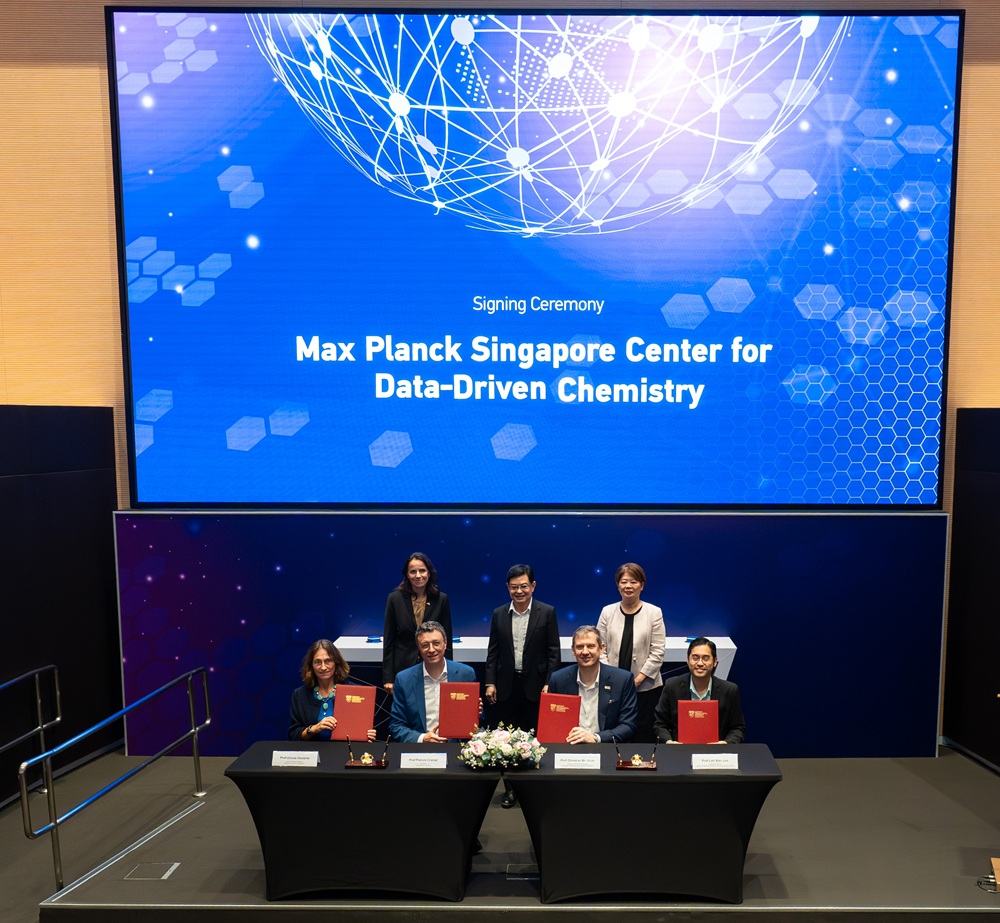
Image: (standing, left to right) German Ambassador to Singapore Dr Bettina Fanghänel; Chairman of the National Research Foundation, Singapore, Mr Heng Swee Keat; and Chairperson of the NTU Board of Trustees, Ms Goh Swee Chen.
NTU Singapore will house the first two Max Planck Centres in Southeast Asia, the Max Planck - Singapore Centre for Data-Driven Chemistry and the Max Planck - NTU Singapore Centre for Biocultural Worlding
These centres are flagship collaborative research initiatives between the Max Planck Society (MPG) in Germany and leading international research institutions. They serve as hubs of scientific excellence, bringing together top researchers from around the world to address frontier questions across diverse disciplines.
The Max Planck - Singapore Centre for Data Driven Chemistry aims to study how the complex volume of chemical research data can be digitalised and analysed effectively to better understand chemical processes and shed light on new reactions.
The Max Planck - NTU Singapore Centre for Biocultural Worlding will study how the close connection between nature and human cultures shape the future of our planet, and what kinds of knowledge and approaches are needed to respond effectively.
NTU President Professor Ho Teck Hua said: "NTU's partnership with the Max Planck Society brings together researchers with complementary trans-disciplinary expertise. Hosting two centres underscores NTU's distinctive strength in interdisciplinary research across science, engineering, and the humanities. The vibrant, collaborative ecosystems of both centres will nurture the next generation of scientists, thinkers, and artists."
Max Planck Society President Professor Patrick Cramer said: "With these two new Max Planck Centres, we are deepening our collaboration with Singapore in two very different, yet equally forward-looking fields of research: data-driven chemistry and the interplay between biodiversity, culture, and knowledge. Singapore has become one of the Max Planck Society's most important partners in Asia. Between 2020 and 2024 alone, Max Planck researchers published more than 800 papers with partners in Singapore. The new Centres bring together international talent and complementary strengths - and create the conditions for discoveries that no institution could achieve on its own."
Both centres were launched on the NTU campus at an event graced by Guest of Honour, Chairman of the National Research Foundation, Singapore, Mr Heng Swee Keat.
Combining chemistry, data, and engineering sciences
The Max Planck - Singapore Centre for Data Driven Chemistry is an innovative joint research initiative between NTU, National University of Singapore (NUS), Agency for Science, Technology and Research (A*STAR), Max Planck Institute of Colloids and Interfaces, and Max Planck Institute for Dynamics of Complex Technical Systems.
The centre will conduct fundamental and highly interdisciplinary research in chemistry, data science, and engineering, bringing together knowledge, expertise, and infrastructure from MPG and the Singapore institutions.
It aims to digitalise chemical research data, develop automated experimental systems, and build artificial intelligence tools to help scientists discover new reactions, design better materials, and optimise chemical processes more quickly and accurately.
This could accelerate the development of new medicines by identifying promising drug compounds faster than traditional laboratory methods, help create more effective fertilisers that improve crop yields while reducing environmental impact, or lead to the discovery of new materials for solar panels that generate cleaner energy more efficiently.
Such research can also be applied to further understanding and refining the complex processes inside batteries to produce batteries that are safer, faster-charging, and longer-lasting.
Researchers will be able to enrol in a mentorship programme that provides training opportunities for junior researchers. There will also be regular visits by researchers and internships in partnering institutions, along with a planned annual symposium to be alternately held at a Max Planck Institute or in Singapore.
Engaging the complex entanglement of biological diversity and cultural life
The Max Planck - NTU Singapore Centre for Biocultural Worlding (CBCW) is housed at NTU's College of Humanities, Arts, & Social Sciences. Initiated by NTU Centre for Contemporary Art Singapore (NTU CCA Singapore) and the Max Planck Institute for the History of Science (MPIWG) in Berlin, Germany, it will be jointly directed and overseen through a partnership across both locations.
The multidisciplinary centre will study the fundamental connections and consequential impacts between the worlds of biology and culture - how biodiversity, their ecosystems and cultural practices shape each other. The CBCW will engage with how people and other beings live, act, and create meaning across different spaces in a shared world.
Drawing on perspectives from the natural sciences, humanities, arts, and indigenous knowledge traditions, it will examine how the loss of a language, the disappearance of a species, or the erosion of a cultural practice are often deeply interconnected and how understanding these links can inform more effective responses to environmental and social change.
By working across disciplines and geographical boundaries, the centre seeks to develop new frameworks for thinking about humanity's relationship with the natural world, with particular attention paid to the diverse ways in which different communities have long understood and sustained that relationship.
The centre brings together researchers, artists, curators, legal scholars, and knowledge-holding communities from different fields of knowledge production to explore how biological diversity and cultural life are profoundly entangled, which in turn shapes the future of the planet. It seeks to explore what knowledge practices are needed to understand and respond to these realities.
It seeks to foster a more reflective and responsible culture of knowledge production, making research conclusions more inclusive and socially robust by ensuring that people from various backgrounds responsibly think through how knowledge is generated, shared, attributed, and sustained across communities.


