
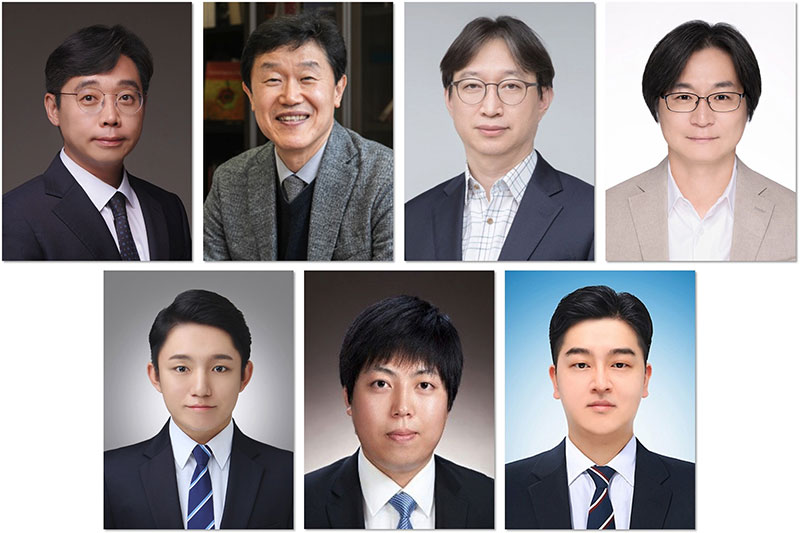
<(Top row, from left) Professor Kang Taek Lee, Professor Joongmyeon Bae, Dr. Tae Ho Shin, Dr. Ki-Min Roh, (Bottom row, from left) Dr. Dongyeon Kim, Researcher Dong Jae Park, Dr. Incheol Jeong>
As ammonia gains attention as a next-generation energy source capable of overcoming the limits of hydrogen storage and transport, KAIST and a joint research team have developed fuel cell technology that directly uses ammonia as fuel while achieving world-class performance and stability. This achievement is regarded as a core technology that will accelerate the commercialization of the next-generation hydrogen economy and carbon-free power generation.
KAIST (President Kwang Hyung Lee) announced on the 20th of May that Professor Kang Taek Lee and Professor Joongmyeon Bae of the Department of Mechanical Engineering, together with a joint research team including Dr. Tae Ho Shin of the Korea Institute of Ceramic Engineering and Technology (KICET, President Jong-Suk Yoon) and Dr. Ki-Min Roh of the Korea Institute of Geoscience and Mineral Resources (KIGAM, President Kwon Yi Kyun), have developed catalyst technology that dramatically improves the performance and durability of ammonia-based protonic ceramic fuel cells (PCFCs, next-generation high-efficiency fuel cells that generate electricity by transporting hydrogen ions).
.jpg)
>
Ammonia is attracting attention as a next-generation hydrogen carrier (Energy Carrier, a medium that stores and transports hydrogen) because it is easy to store and transport in liquid form. It is also regarded as a representative carbon-free fuel because it consists only of nitrogen (N) and hydrogen (H), producing almost no carbon dioxide (CO₂) during power generation. However, inside fuel cells, ammonia has caused problems by damaging nickel-based materials and slowing reaction rates, leading to performance degradation and shortened lifespan.
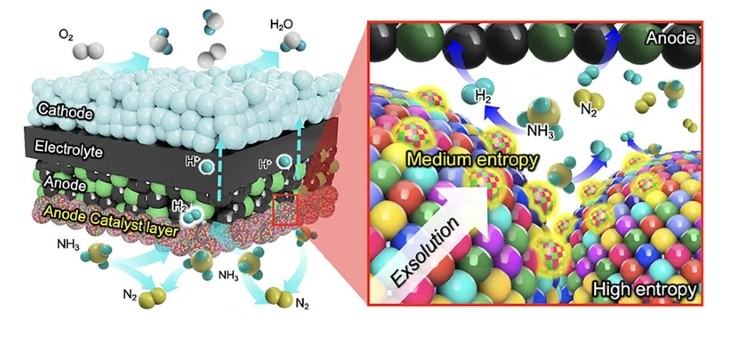
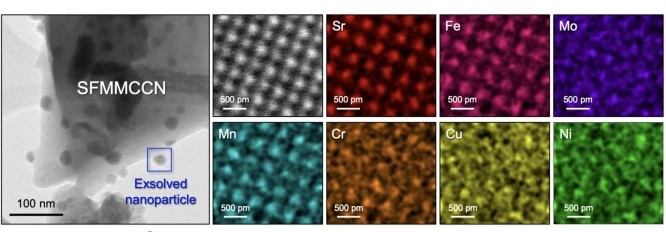
To solve this problem, the research team designed a new catalyst structure combining a "high-entropy" oxide catalyst (High-Entropy, a design method that enhances material stability and performance by mixing multiple elements) that improves structural stability by mixing multiple elements, with metal nanoparticles (Nano Particle, ultrafine metal particles on the nanometer scale) that form spontaneously on the surface during operation.
This catalyst was found not only to resist structural collapse even in an ammonia environment, but also to effectively promote the reaction that decomposes ammonia into hydrogen. Through density functional theory (DFT, Density Functional Theory, a simulation method that calculates reaction mechanisms at the atomic level) analysis, the research team identified that the high-entropy oxide structure lowers the energy barrier required for ammonia decomposition and promotes the formation of metal particles.
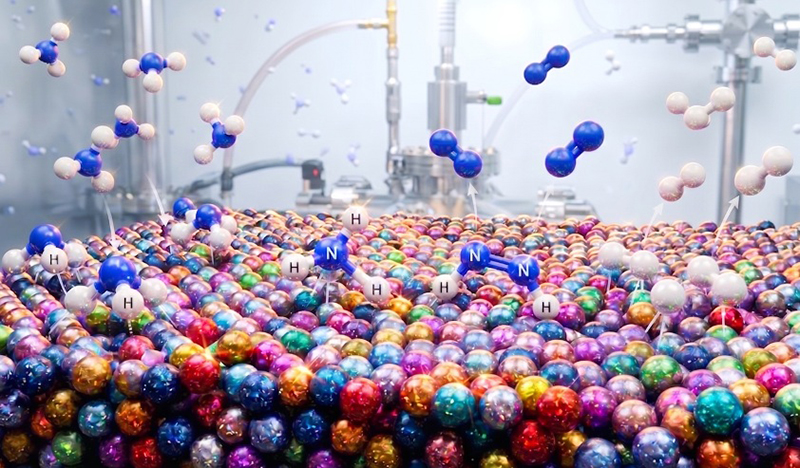
In particular, the metal alloy nanoparticles that formed spontaneously on the catalyst surface showed much higher catalytic activity than single-metal catalysts. A fuel cell applying this catalyst recorded a maximum power density of 2.04 W per unit area (1 cm²) at 700°C. This means that high power can be produced from an area the size of a fingernail, representing world-class performance in the field of ammonia-based protonic ceramic fuel cells that generate electricity by transporting hydrogen ions (protons).
In addition, the cell operated stably for more than 255 hours even under harsh conditions of 600°C, significantly improving the problem of performance degradation (a phenomenon in which performance decreases over time) seen in existing catalysts.
Professor Kang Taek Lee stated, "Through the synergistic structure of high-entropy oxides and alloy nanoparticles, we improved both the performance and durability of ammonia fuel cells," adding, "This study will serve as a catalyst for accelerating the commercialization of ammonia-based carbon-free power generation technology and next-generation hydrogen energy systems."
This research, with Dr. Dongyeon Kim of the Department of Mechanical Engineering at KAIST, researcher Dong Jae Park of the Korea Institute of Ceramic Engineering and Technology, and Dr. Incheol Jeong of the Korea Institute of Geoscience and Mineral Resources as co-first authors, was published on April 17 in Nano-Micro Letters (IF: 36.3), an international journal in the fields of energy and materials.
※ Paper title: "Entropy-Modulated Oxide–Metal Catalyst Architectures for Direct Ammonia Protonic Ceramic Fuel Cells," DOI: https://link.springer.com/article/10.1007/s40820-026-02194-9
This research was supported by the Mid-Career Researcher Program of the Ministry of Science and ICT, the Global Basic Research Laboratory Program, the InnoCORE Program of the Institutes of Science and Technology, and the Basic Research Project of the Korea Institute of Geoscience and Mineral Resources.


